Botulinum toxin has transformed the treatment of focal dystonia.

Botulinum toxin (Botox) has transformed the treatment of focal dystonia over the last 25 years. Dr Marion lectured at the SENA meeting about the contribution of Botox to neurology…

South of England Neurology Association (SENA)

The 2nd December, St George’s Hospital

Botulinum toxin (BTX/ Botox) has transformed the treatment of focal dystonia.


Dr Jeff Kimber, neurologist organised The South of England Neurology Association (SENA) meeting, hosted this time at St George’s Hospital, London. In the morning session, several talk were on movement disorders. Dr Salah Omer gave a lecture on Progressive Myoclonic Epilepsy, and Dr Bridget Mcdonald adressed the questions of the long term prognosis of cerebral palsy. I gave a lecture on the contribution of Botulinum toxin to Neurology over the last 25 years. 

In 1985, I remembered as a research fellow running a clinic dedicated to patients with cervical dystonia for which the only treatment was anticholinergic drugs (triheyphenidryl, procyclidine), physiotherapy and peripheral denervation surgery (cutting the nerves of the neck muscles). Patients with focal dystonia have always a major functional disability as the dystonic spasms are triggered by action. Oromandibular dystonia is the source of chewing or speaking difficulties. Blepharospasm can lead to functional blindness. Writer’s cramp stops the patient writing. Cervical dystonia interferes with walking, writing, working in front of a screen. Spasmodic dysphonia  makes talking on the phone an impossible task…

Botox treatment has been a revolution for these patients, giving them a relief and the possibility to carry on their daily activities.

 It’s important to inform the public and the funding body in healthcare profession that Botulinum toxin is not a beauty cream but a major therapeutic tool and  that every department of neurology should be given the resources to offer this treatment to their patients.

Marie-Helene Marion

London Btx Centre

More than a wink!

A little twitch under the eye (Benign Eyelid Myokimia)

It’s not rare to have a jumpy lower eyelid when tired. It comes and goes, it’s upsetting when trying to read or when talking to somebody; it’s worst when drinking too much coffee, lacking of sleep or being under pressure. It’s called Benign Myokimia and it usually disappears without any treatment after rest and relaxation. Don’t hesitate to talk to your GP if it persists.


A spasm of one side of the face (Hemifacial spasm)

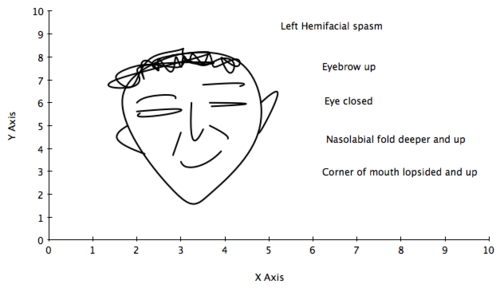
Less commonly the twitch in the eyelid continues and spreads to the upper lid with a tendency to close the eye. It also spreads very gradually to the cheek, and to the corner of the mouth, which starts twitching at the same time. The person looks like winking to somebody with the sudden eye closure and the cheek pulled up. Of course it’s very embarrassing in public and can lead to some misunderstanding!


Life with Hemifacial spasm.

It interferes with daily life activities like reading. Patients find very tiring to cope with the facial spasm every day. It is worst when going to bed and falling asleep. Every muscle on one side of the face can be jerky from the forehead (Frontalis) muscle to the muscle of the skin of the neck ( Platysma). Patients often are embarrassed when meeting people for the first time. It’s more than a wink!


The diagnosis of hemifacial spasm is not always easy!

The spasm is intermittent and often not present during the clinic, like the toothache disappears when sitting in the dentist ‘s chair! The trick is to stretch the muscles of the face to trigger the facial spasm; I ask the patient to do a forceful smile or to close very tight the eyes for few seconds; following these stretches, the facial muscles start to jump on one side of the face. The diagnosis is then much easier for the doctor.


Why one side of my face is jerky?

The facial muscles on one side become too active, due to an irritation of the facial nerve on the same side. The irritation is most often due to an artery, which forms a loop and rubs against the facial nerve.


What is the treatment?

Botulinum toxin injections are indicated at the first line treatment for hemifacial spasm, as the side effects are very limited and always transient. The results are very good in 80% of the cases. The limitation of the injections is the necessity to repeat them every 4 months and the difficulty to control severe spasm around the mouth without changing the smile.

The surgeon can put a pad of Teflon between the vessel and the nerve to separate them; this surgical treatment calls vascular decompression and is performed by neurosurgeon, trained in this type of surgery. It is usually discussed after having tried Botulinum toxin treatment.


Sweating in Winter: a serious problem


Sweating in summer on a hot day or after a long Sunday jog may feel good, or at least normal. But sweating in winter when the weather is cold or you just come out of the shower can be a nightmare for individuals suffering from a condition called Hyperhydrosis (also spelled Hyperhidrosis).


Primary Hyperhydrosis or excessive sweating is in third of the cases a familial condition, which can have various manifestations, depending of the site of the excessive sweating; “primary” means that no obvious cause such as drugs, diabetes, infection etc.. is associated with the excessive sweating. Excessive sweating, in particular starting in adulthood and without family history should be investigated by the GP as it could be secondary sweating.

Armpits sweating:

 In case of Primary Hyperhydrosis affecting  the armpits, it’s often  young adults complaining of sweat marks on their clothes under their arms since their teens. They avoid colourful and white clothes and prefer dark clothes to not show the marks; they feel ashamed and loose their confidence as they are wrongly convinced that the excessive sweating under the arms is associated with excessive body odours. They bring extra clothes at school or at work to change during the day.

Hand sweating:

It can also affect the hands, usually noted when the child learned to write at the age of 5; the pen slipped out the hand; they made wet mark on the paper when writing. then these children don’t dare holding hands of their friends at primary school and later on avoid social contacts; it can also affect  professional manual skills.

Feet Sweating:

The excessive sweating of the feet is usually well tolerated in winter where the socks in the shoes absorb the sweat and I have met patients who were convinced that to have wet socks were normal at the end the day. The worst is in summer when ladies try to wear open sandals, in particular with some heels; the sweaty wet feet slip out and make walking hazardous. I have heard alos young men distress about having wet feet in bed.

Facial sweating:

Facial sweating is also very distressing. The sweat can drip from the scalp, or the forehead along the face, the cheeks and the nose and in back of the neck leaving the hair wet.

Excessive sweating people can benefit from treatment and is not related to excessive shyness or anxiety but it’s a true condition.

Please don’t hesitate to contact support group such as the Hyperhidrosis Support Group at www.hyperhidrosisuk.org

Dr MH Marion is running specialized clinics for all types of primary hyperhidrosis both at St George’s Hospital, London (UK) and at the  London BTX centre.

Few words about me… Dr Marie-Hélène Marion

Few words about me…

Dr Marie-Hélène Marion, specialist in Botox treatment for 25 years.

My name is Marie-Hélène Marion and I am a consultant neurologist, specialized in the use of Botulinum toxin (also called Botox) in Neurology. I started blogging 2 months ago about Botox, Dystonia and Hyperhydrosis and I enjoyed every minute of it. Of course at the beginning I had some hesitations, but quickly I realized that blogging for patients and talking to patients during a clinic, have a lot in common, except that you don’t know and you don’t see the reactions of your readers.

My training

I studied medicine at the University of Clermont-Ferrand in the heart of the beautiful volcanic region of Auvergne. Then went to Paris to study Neurology as an “ Interne des Hopitaux de Paris” in the most prestigious departments of that time and in parallel studied Neuro-pharmacology (how the drugs work in the brain)

Then I started to have itchy feet and went to London to specialize in movement disorder as a research fellow under Professor David Marsden for 2 years. His passion for Parkinson’s disease, Dystonia and the all field of involuntary movement was contagious and never left me since.

My work as a movement disorder specialist on both sides of the channel

I went back to Paris in September 1986 to work as a Chef de Clinique and pioneer in France the use of Botulinum toxin in Neurology. Then in 1998 I crossed again the channel to follow my Australian husband and worked for 12 years at St George’s hospital, in London, running Movement disorders clinics and various Botulinum toxin clinics. At St George’s I still run a clinic specialized in excessive sweating, in particular facial sweating and hands sweating, and a clinic for voice disorders and severe bent neck.

The London BTX Centre

Now my main clinical activity is at the London BTX Centre in Sloane Square that I founded 6 years ago, dedicated to the treatment of focal dystonia, (Blepharospasm, Cervical dystonia, Jaw dystonia, Writer’s cramp, Musician’s cramp), Hemifacial spasm, Facial palsy, Tremor, Bruxism and excessive sweating.

A special mention for patients with voice disorders who are seen in a joint clinic, unique in London, with an ENT-voice specialist (Ms Lucy Hicklin) and a neurologist (MH Marion).

Dr Marie-Helene Marion (neurologist) and MS Lucy Hicklin ( ENT surgeon, Voice specialist)

Academic interests

In parallel, I pursue academic projects in the movement disorders field and published this year on Parkinson’s disease and also on complex cervical dystonia with my junior colleagues at St George’s Hospital. I recently organized the British Neurotoxin Network (BNN)  which gathered all the clinicians over UK who are running Botox services for neurological conditions.

I am a regular invited speaker in international meetings on the field of movement disorders and organized workshops on the use of Botox treatment in neurology, as European expert in the field.

What makes my head turn?

What makes my head turn? Find out with Dr Marion, neurologist which muscles of the neck are responsible of turning the head on one side in neck dystonia

What makes my head turn?

The neck muscles involved in the involuntary posture in cervical dystonia need to be identified for Botulinum toxin injections and physiotherapy. Here are some hints.

See the sketche below.

The head is placed on the top of the cervical spine and can pivot about 90 degrees on both sides. The pivot of the head is possible if one neck muscle is pulling forward and if another one on the other side is pulling backward.

The Sterno-Cleido-Mastoid (SCM) muscle

is the muscle pulling forward and rotating the head to the opposite side (right SCM turns the head to the left).

The Splenius Capitis

is the muscle pulling the head backward and rotating the head to the same side (left Splenius turns the head to the left).

The SCM muscle is a long superficial muscle easy to palpate on the front of the neck, and the Splenius is a deep muscle, difficult to palpate, behind the ear.

The shoulder muscles

In addition, there are 2 muscles which are both neck and shoulder muscles: the Levator scapulae and the Trapezius ; both lift up the shoulder, but the Levator scapulae is a deep muscle,   responsible for the posture “shoulder up and forward “ and works with the Splenius  in turning the head to the same side (the left Levator Scapulae will contribute with the left Splenuis to the rotation of the head to the left, )

The Trapezius is a superficial muscle and can contribute to the rotation of the head to the opposite side, working together with the SCM (the right Trapezius will contribute with the right SCM to the rotation of the head to the left).

These muscles are the most frequent targets for Botulinum toxin injections to control the dystonic rotation of the head. The palpation of these muscles is important, as dystonic muscles feel more bulky under the fingers.

It may sound complex but looking at the drawing should make it simpler to grasp…

Marie-Helene Marion

London BTX centre


“With Africa, for Africa”: The World Congress of Neurology

At the XXth World congress of Neurology in Marrakesh, yesterday a group of French neurologists (Dr Christophe Vial from Lyon, Pr Pierre Krystkowiak from Amiens,) with Pr Ouafae Messouak from Fes (Morocco) and I run a workshop of Botulinum toxin injection techniques in Neurology. It was a great success with more than 45 people attending and working with us all day. We had colleagues from Morocco, Tunisia, Ghana, Kenya, Nigeria, Sudan, Syria, Lebanon,  the Emirates, India, Thailand, Belgium, Norway and USA. Mr. Olivier Seguin from the drug company Allergan kindly provided mannequins (called Elvis and Elvira !) which help us to do some “hands on” practices.

It was a very interactive teaching where we met our colleagues in particular from Africa. The BTX services in Africa already exist, in particular in Maghreb where there are very active (Algeria, Tunisia, Morocco). In the other part of Africa, and the Middle East the development of the services is based on individual’s initiative of neurologists, with an interest in movement disorders.

Talking with our African colleagues, we felt the need for setting up an African and Middle East Neurotoxin Network  (AMENN), following the model of the British Neurotoxin Network (the BNN). It will help the neurologists to be less isolated in their practices, and to allow African patients to access services locally without travelling at great cost to Europe for treatment many times a year.

“With Africa, for Africa” was the motto of this world congress.

Picture of the workshop faculty

Dr Marie-Helene Marion  (London BTX centre), Dr Christophe Vial (Lyon, France), Pr Ouafae Messouak (Fes, Marocco), Pr Pierre Krystowiak (Amiens, France)


The diagnosis of Blepharospasm is always delayed!

     The diagnosis of Blepharospasm is always delayed!

Blepharospasm is a focal adult- onset dystonia, responsible of an involuntary eye closure. It can start with an increased blinking explained by dry eyes, gritty eyes or intolerance to bright lights. Gradually the patient, more often a woman around her 60’s, complains of difficulty to watch TV, to drive at night or just to walk outdoors on a cloudy day

At that stage, surprisingly the diagnosis is not easily done. Why?

1-    The GP refers this lady to the eye clinic; the diagnosis of blockage of the lacrymal ducts, or of blepharitis (with an inflamation of the eyelids) are much more common conditions and often the first to be considered.

2-    The patient does not spontaneously mention that the eyes are involuntary closing. They more often talk about their heavy eyelids, or tired eyes, or intolerance to bright light (also called photophobia)

3-    The patient has often the eyes well opened when speaking and the doctor can’t document any forceful eye spasms during the clinic.

This explains that the diagnosis of dystonia (Blepharospasm, Cervical dystonia) is usually made after 5.4 years on average after onset of symptoms and at least after seeing 3 different consultants (Canadian survey of Dr Jog ).

The patient will benefit to come to the first clinic with a relative or a friend who may describe it more accurately as an external observer. I also ask my patients to stop talking and be silent for few minutes, fixing a visual target in the room; the spasms with forceful eye closure will occur 2 to 3 minutes later. It’s worthwhile waiting as it’s a great opportunity not only to make the diagnosis but also to identify the type of Blepharospasm.

 Hope this blog will contribute to an earlier diagnosis of Blepharospasm!

 Reference: Causes of treatment delays in dystonia and hemifacial spasm: a canadian survey. Jog M et al, Can J Neurol Sci 2011: 38:704-11

So many different types of focal dystonia!

So many different types of focal dystonia!

 Depending of the body part affected,

 ·      Eye closure is called Blepharospasm (blepharo means eyelid in Greek).

·      Jaw opening or clenching is called Oro-mandibular dystonia (oro means mouth and mandibular means jaw in Latin).

·      Tongue protrusion is called Tongue dystonia

·      Twisting of the head to one side is called Cervical dystonia (cervic means neck in Latin).

·      Writing difficulty is called Writer’s cramp.

·      Back arching, or trunk bending forward is called Axial dystonia (axial means axis as the spine).

·      Walking or running difficulty is called the “ Crampe du marcheur” in France!

·      Difficulty playing a musical instrument is called Musician’s cramp.

·      Speaking difficulty is called Spasmodic dysphonia (phonia means the speech).

 They usually start in adulthood and remain focal, without spreading to adjacent part of the body.

There is more than one Botulinum toxin!

There are 4 different botulinum toxin brands available in UK; let’s Dr Marion guide you through the pharmaceutical maze of the botulinum toxin.

Various names and abbreviations are attached to Botulinum toxin.    I hope these explanations will make reading and listening about the topic less confusing….

– Botulinum toxin is called a Neurotoxin as it’s a toxin, which is active on the nerve, controlling the action of the muscles or the secretion of the glands.

-Botox is often used in newspaper, magazine and on Internet as a generic name instead of Botulinum toxin. BOTOX is one of the brand names, registered as a trademark, and it uses inappropriately like Kleenex for facial tissue paper.

-There are 3 Botulinum toxins type A (BOTOX, DYSPORT, and XEOMIN) and 1 type B (NEUROBLOC), available in UK for therapeutic uses. The FDA (Food and Drug administration which is a regulatory body for drugs in USA) has decided to give 4 different chemical names to each of these brands, as there is no standard equivalence between the numbers of units of these brands. Ona-botulinumtoxinA for BOTOX, Abo-botulinumtoxinA  for Dysport, Inco-botulinumtoxinA for Xeomin, Rima-botulinumtoxinB for Neurobloc.

-To add to the complexity of the story, the abbreviations are also changing. We used commonly Botox, BTX, and recently we have been asked to use BoNT-A (pronounce Bonte) and BoNT-B by the scientific community!

But don’t worry too much! Despite or because of all these various labels, neurologists communicate well between each other about the treatment of their patients.

H.Oppenheim, 100 years ago was the first to use the word “ Dystonia”…

H.Oppenheim, 100 years ago was the first to use the word “ Dystonia”…what does the word Dystonia means? Dr Marion will take you back 100 years ago…

Dystonia is a neurological condition, characterized by involuntary sustained pulling of the muscles in one part of the body (focal dystonia, mainly in adult) or spread in the all body (generalized dystonia, mainly in children) and associated with abnormal postures.

The word “Dystonia” is composed of Dys (meaning abnormal) and Tonia ( meaning the tone ) . The tone represents how flexible or stiff is a part of the body. Oppenheim coined the word “Dystonia” in 1911 to describe an abnormal muscle tone, different from what was observed following stroke (spasticity). Oppenheim described children, from Ashkenazi Jewish descent, affected with generalized dystonia and called this condition “ Dystonia musculorum deformans”. In 1989, Laurie Ozelius established that a gene (called DYT1) on chromosome 9 was responsible of the ‘Oppenheim dystonia”.

 http://en.wikipedia.org/wiki/Hermann_Oppenheim

http://brain.oxfordjournals.org/content/97/1/793.extract

http://www.ncbi.nlm.nih.gov/pubmed/2576373